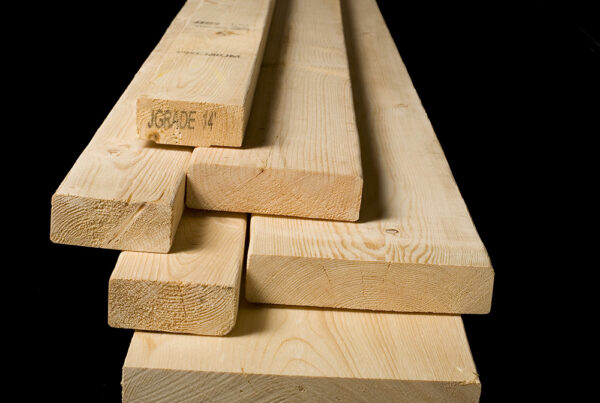


Ask anyone who’s picked up a “2×4” at the lumberyard, measured it, and found it’s actually 1.5 inches by 3.5 inches. It feels like a bait and switch. But the story behind that missing half-inch (or more) says a lot about how the lumber industry evolved to be more precise, more efficient, and more standardized than it used to be.
The Old 2×4 Really Was 2×4
Back in the early 1900s, a rough-cut board fresh off the saw actually did measure close to 2 inches by 4 inches. Lumber wasn’t planed smooth or dried to a consistent moisture level before it left the mill, so what you bought was closer to its raw, sawn dimension.
Planing and Drying Took Away the Difference
As mills modernized, they started surfacing lumber on all four sides to give it smooth, uniform faces, and they began kiln-drying boards to reduce moisture content before shipping. Both processes shave material off the board, and both make the wood more stable and easier to work with, but neither one leaves the original rough-cut size intact.
Standardization Made the Shrinkage Official
By the mid-20th century, the industry needed everyone, from mills to builders to code inspectors, working from the same numbers. In 1964, the American Softwood Lumber Standard formally locked in today’s dressed sizes, so a 2×4 became a nominal name for a board that measures 1.5 by 3.5 inches, no matter which mill it came from.
Why the Industry Never Went Back
Once builders, architects, and building codes were designed around those standardized dimensions, changing them again would have meant rewriting span tables, fastener specs, and construction plans across the entire industry. The nominal size stuck around because it’s a shared language, even though it no longer matches the tape measure.
What This Means for You Today
When you’re framing a wall or building a deck, remember that “2×4” and “2×6” are labels, not literal measurements, and every span table, joist calculator, and fastener schedule you’ll use already accounts for the real, dressed dimensions. Once you know the trick, the numbers stop being confusing and start being useful.