
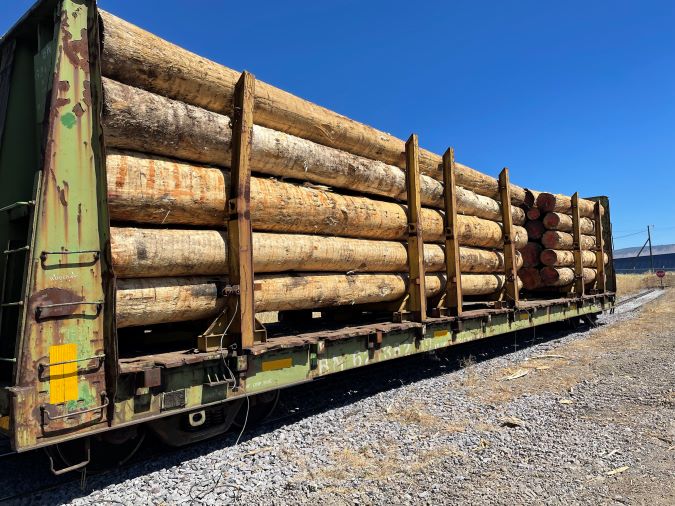
Long before trucks and interstates moved lumber, railroads did the heavy lifting. Rail expansion in the 1800s didn’t just move people and goods. It reshaped where lumber came from and how far it could travel. Some of those changes still show up in the industry today.
Lumber Started Out as a Regional Product
Before rail reached deep into the country’s forests, lumber markets were mostly regional. The industrial revolution drove national demand for timber. Railroads alone used a fourth of that demand, building rail cars, stations, and ties. Early production centered in the Northeast. By 1840, upstate New York and Pennsylvania were the seat of the industry. By 1880, the Great Lakes region had taken over as the dominant producer. Wood was heavy and expensive to move without rail access. Builders relied on lumber from whatever region could actually reach them.
Railroads Opened Up Distant Forests as the Midwest Ran Low
As Midwest timber supplies thinned, rail lines pushed lumber production further west and south. The timber supply in the Midwest was dwindling, forcing loggers to search for new sources of what was sometimes called “green gold.” By 1900, upper Midwest supplies were dwindling too, pushing loggers toward the Pacific Northwest. By 1920, that region was producing around 30 percent of the country’s total lumber output. Transcontinental rail lines made this shift possible. The Northern Pacific reached Portland in 1883. The following year, the Oregon Short Line connected to the Columbia River, opening the Blue Mountains to logging.
Rising Prices Pushed the Industry Toward New Regions
The shift west wasn’t only about railroads reaching new forests. It was also about the Great Lakes running short and getting expensive to log. As Midwestern timber prices rose in the late 1800s, companies looked for alternatives. West Coast stands became more attractive. So did Southern pine forests, after an 1876 law opened them to logging. By the turn of the century, the South and Far West dominated the market. Rail access made both regions commercially viable in a way they hadn’t been before.
Rail Access Mattered More Than Timber Quality Alone
Having good timber wasn’t enough on its own. A region also needed a practical way to get that timber to market. One historian summed it up simply: colonization was the greatest contribution the railroad made to the far West. Where rail access didn’t yet exist, mills relied on rivers and log rafts, or built their own narrow-gauge railroads just to reach a main line. In the 1800s, lumber was sometimes floated down rivers on huge log rafts, with a single raft carrying around 180 tons. That method worked, but it was slow and limited compared to rail.
Logging Railroads Became Part of the Industry Itself
As easily accessible timber near waterways ran out, mills built their own rail lines to reach what was left. The exhaustion of timber near navigable waterways created the need for railroad spurs connecting inland sawmills to the national rail network. These logging railroads, often temporary narrow-gauge lines built into the woods, became standard practice, especially in the Pacific Northwest and the South.
Consolidation Followed the Railroads
Rail access also changed who ran the industry. Once lumber could travel long distances affordably, it became easier for a small number of large operators to dominate. By the late 1800s, the industry shifted away from individuals managing single mills and selling to wholesalers. Large industrialists who owned multiple mills and their own timberland took over. None was bigger than Frederick Weyerhaeuser, whose company started in 1860 in Rock Island, Illinois, and expanded into Washington and Oregon. By his death in 1914, it owned over 2 million acres of pine forest.
The Railroad Boom Set the Foundation for Modern Distribution
By the time trucks became the dominant way to move lumber, railroads had already set the pattern the industry still follows. Production had spread from the Northeast, to the Great Lakes, to the Pacific Northwest and South. Rail access was the deciding factor at each stage. Large, vertically integrated companies had replaced small local mills. The idea that lumber could move efficiently across the country, and that buyers could trust wood shipped from distant regions, took shape during the rail era.
Why This History Still Matters Today
This history explains the industry’s current geography. The Pacific Northwest is known for Douglas fir. The South is known for Southern yellow pine. Both regions grew into that role partly because rail access made large-scale shipping possible. National distribution, and the trust buyers place in lumber from distant mills, both have roots in a period when reaching a railroad, not just growing good timber, decided which regions became major players.