
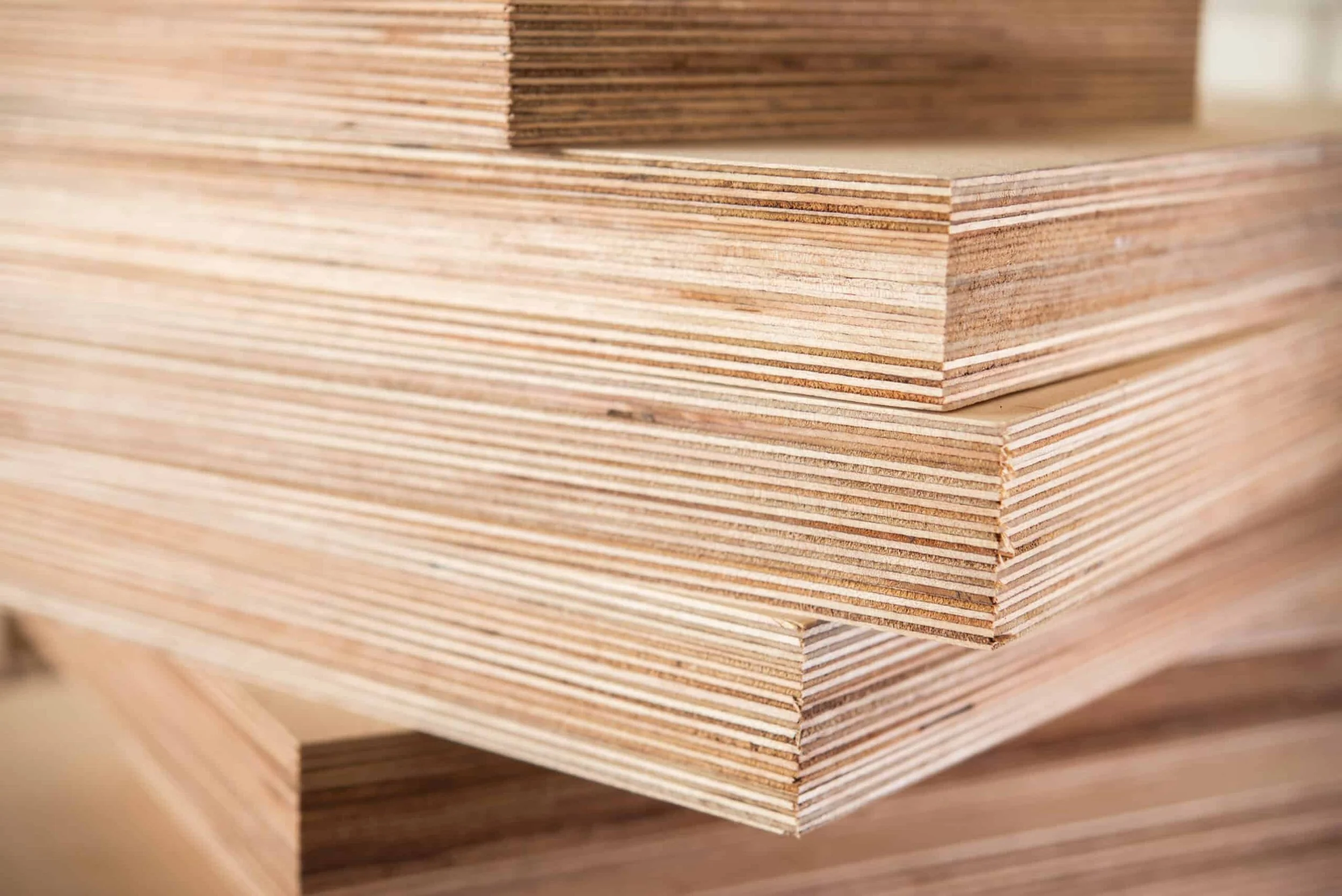
Pick up a sheet of plywood and look at its edge. Count the layers, or plies, stacked inside, and you’ll almost always land on an odd number: three, five, seven, or more. This isn’t a manufacturing accident or a marketing gimmick. It’s basic wood engineering, and understanding it makes it easier to pick the right sheet for the job.
Plywood Gets Its Strength From Crossing Grains
Each layer of veneer in a sheet of plywood is rotated 90 degrees from the layer beneath it, so the wood grain runs in alternating directions through the stack. That cross-graining is what gives plywood its strength in both directions and keeps it from splitting the way a solid board would.
An Odd Number Keeps the Sheet Balanced
For that alternating pattern to work, the top and bottom faces of the sheet need to run in the same grain direction, which only happens if there’s an odd number of layers. With an odd count, the layers mirror each other around a center ply, so the sheet pulls evenly and stays flat instead of warping or cupping.
Even-Numbered Sheets Would Fight Themselves
If a sheet had an even number of plies, the outer faces would end up running in different directions, and the two sides would expand and contract at different rates as humidity changes. That imbalance would leave the sheet more prone to bowing, twisting, and general instability over time.
The Center Ply Does the Least Visible Work
The core, or center layer, doesn’t get much attention, but it’s what holds the whole balanced structure together and gives the sheet its thickness without adding unnecessary weight. In thicker sheets, this middle section is often made from lower-grade veneer since it’s sandwiched away from view and stress is more evenly distributed across the whole panel.
Why This Matters When You’re Buying Plywood
The next time you’re choosing plywood for a subfloor, sheathing, or a furniture project, the ply count is a quick signal of how stable and rigid that sheet will be under load. More plies generally mean a stronger, more dimensionally stable panel, which is worth knowing before you reach for the cheapest sheet on the rack.