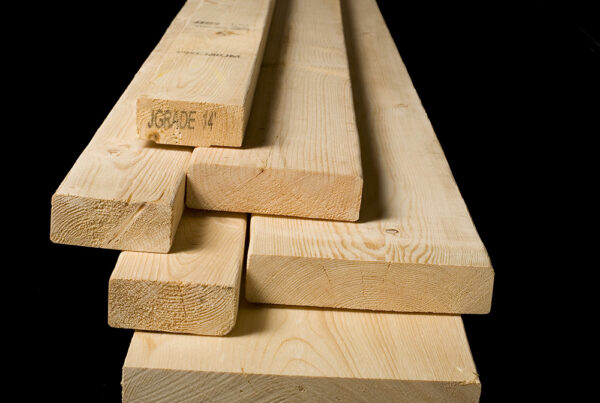


Every stud stamped “KD” or “S-DRY” is telling you something specific: this board has 19% moisture content or less. That number isn’t random. It’s the line the industry settled on decades ago, and it still holds up today.
Wood Never Goes Fully Dry
Even lumber that feels bone-dry still holds some water inside its cells. Wood is naturally porous, so it constantly absorbs and releases moisture from the air around it. “Dry” lumber doesn’t mean zero moisture. It means the moisture has dropped low enough to stop causing problems.
19% Is the Point Where Shrinkage Slows Down
Fresh-cut lumber can start out well above 30% moisture content. As it dries, it shrinks fastest in the early stages, then the shrinkage rate levels off. Testing showed that once a board drops to around 19%, most of the major shrinking is already done. Below that line, a board holds its size and shape far better.
It’s Also the Point Where Strength Stabilizes
Wet wood is weaker than dry wood. As lumber dries, its strength increases, up to a point. Research on structural lumber found that strength values level off around the same 19% mark. That’s part of why the number shows up in structural grading standards, not just visual ones.
The Standard Locked In With Building Codes
Once testing pointed to 19% as the threshold, the lumber industry and building codes adopted it as the official cutoff for “dry” lumber grading. That gave mills, inspectors, and builders one shared number to design around, instead of a range of guesses.
Why the Number Still Matters Today
A board stamped below 19% moisture is more dimensionally stable, less likely to warp, and closer to its final strength. That’s why the number still appears on grade stamps today, decades after it was first set. It’s a simple way to promise a board will behave the way it’s supposed to once it’s in a wall.