

When most people think about lumber production, they assume every board that comes out of a sawmill is ready to be sold as construction material. In reality, a significant amount of lumber does not initially meet the grade or specifications that mills were hoping to produce. Rather than being discarded, these boards often find alternative uses, are reprocessed into different products, or are sold into markets where their characteristics are still valuable. Understanding what happens to off-grade lumber provides an interesting look into how the wood products industry maximizes value and minimizes waste.
Not Every Board Makes the Cut
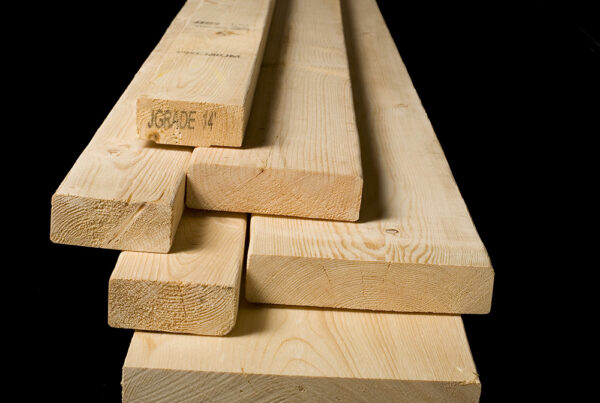
Lumber grading is based on strict industry standards that evaluate characteristics such as knots, splits, wane, warp, grain deviation, and other natural defects. During the grading process, some boards fail to meet the requirements of the grade they were originally intended to achieve. This does not necessarily mean the lumber is unusable. It simply means the board must be classified differently based on its actual characteristics and performance potential.
Most Lumber Is Downgraded, Not Rejected
The most common outcome for lumber that misses its target grade is a downgrade. For example, a board intended to qualify as #2 may instead be graded as #3 if it contains larger knots or other defects beyond the allowable limits. While the downgrade reduces the value of the piece, the lumber can still be sold and used for applications where lower grades are acceptable. This allows mills to recover value from material that falls short of higher-grade standards.
Some Lumber Is Remanufactured
Certain boards can be improved through additional processing. Mills may trim off defective sections, cut boards into shorter lengths, rip them into narrower pieces, or remanufacture them into specialty products. By removing the portion that caused the grading issue, the remaining wood can often be sold as a higher-value product than it would have been in its original form.
Industrial Markets Create Additional Demand
Lumber that does not meet construction-grade requirements often finds a home in industrial applications. Pallets, crating, packaging materials, blocking, dunnage, and other industrial products typically have different appearance and performance requirements than structural lumber. Material that may not be suitable for framing a home can still perform perfectly well in these applications, creating another outlet for mills to sell off-grade production.
Wood Fiber Rarely Goes to Waste
Even lumber that cannot be sold as boards still has value. Lower-quality material can be chipped and used to manufacture products such as paper, pulp, particleboard, MDF, biomass fuel, or wood pellets. Modern mills are highly efficient operations that aim to utilize nearly every part of the log, turning what would otherwise be waste into marketable products.
Grade Targets Affect Mill Economics
Every mill has a desired production mix based on market demand and pricing. When a larger percentage of lumber is downgraded than expected, the mill receives less revenue from the same volume of logs. For this reason, mills closely monitor recovery rates, grading outcomes, and manufacturing processes to maximize the amount of lumber that qualifies for higher-value grades while still utilizing lower-grade material effectively.
Why This Matters to Buyers
Many buyers assume lumber falls into two categories: acceptable or rejected. In reality, there is a wide range of grades and markets that allow wood products to be utilized efficiently. Understanding the downgrade process helps explain why lower grades exist, why pricing varies between grades, and how mills are able to produce value from nearly every log they process.
Final Thoughts
Lumber that does not meet its intended grade is rarely thrown away. Most boards are downgraded, remanufactured, sold into industrial markets, or converted into other wood products that still have commercial value. The ability to find productive uses for off-grade material is one of the reasons the lumber industry operates so efficiently. From framing lumber to pallets to paper products, nearly every piece of wood harvested from a tree ultimately finds a purpose.