
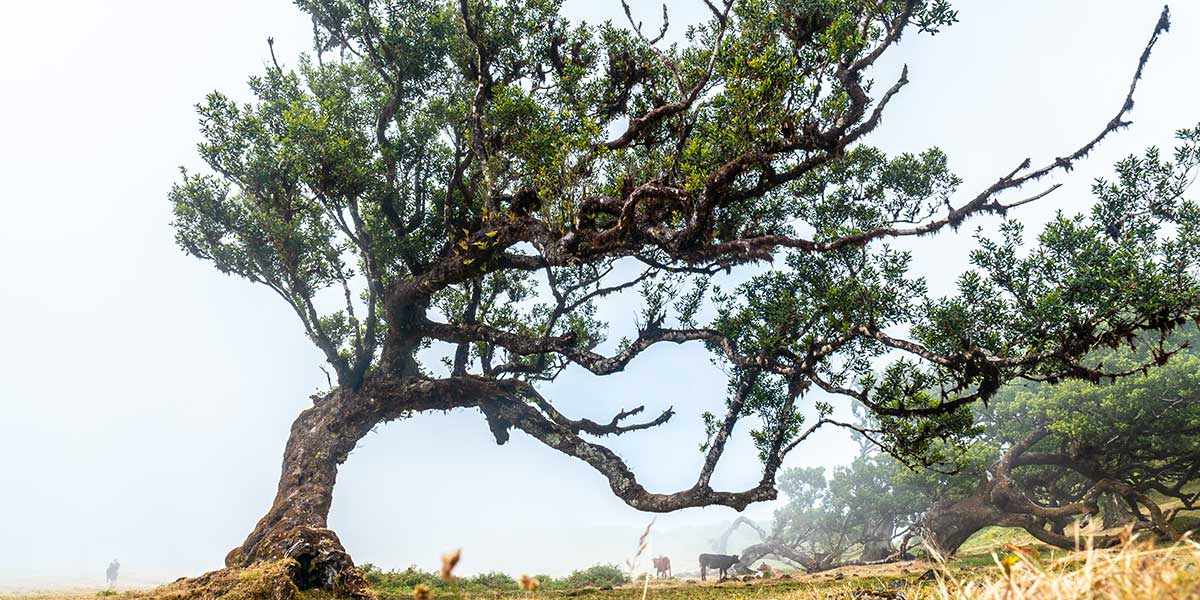
If you’ve ever walked through a forest, you’ve probably noticed that not every tree grows perfectly straight. Some lean dramatically, twist as they climb, or bend in unusual directions. While a straight tree is often ideal for producing lumber, nature has other priorities. A tree’s shape is influenced by its environment, its competition, and even its genetics.
Wind
Constant wind forces trees to adapt throughout their lives. In windy areas, trees often develop thicker trunks and stronger root systems to stay upright. If strong winds regularly blow from one direction, a tree may gradually lean or curve as it grows. These stresses can also influence the grain of the wood, sometimes producing unique patterns that woodworkers value.
Slope
Trees growing on hillsides rarely stand perfectly vertical. To maintain balance, they adjust their growth over time by leaning uphill or curving toward open space. Their root systems also spread differently to anchor themselves in uneven terrain. This natural response helps the tree survive but can create curved logs that produce less dimensional lumber.
Competition
In a crowded forest, every tree competes for sunlight. Young trees often bend and stretch around neighboring trees to reach open sky. This competition can create sweeping curves, angled trunks, and irregular growth patterns. Once the surrounding trees are removed, those curves remain for the rest of the tree’s life.
Sunlight
Trees naturally grow toward light, a process known as phototropism. If sunlight is blocked on one side by nearby trees, buildings, or mountains, the tree will gradually lean toward the brighter side. Over many years, even a slight lean can become a dramatic curve.
Genetics
Not every tree is programmed to grow the same way. Genetics influence growth rate, branch structure, trunk shape, and overall form. Some species naturally grow straighter than others, while individual trees may develop twists or irregular shapes simply because of their genetic makeup. This natural variation is one reason every log is unique.
What This Means for Lumber
The straighter a tree grows, the more high-quality dimensional lumber can usually be produced from each log. Curved or twisted logs often yield shorter boards or specialty wood products instead. Modern sawmills use advanced scanning technology to determine the best cutting pattern, ensuring that every log is used as efficiently as possible, regardless of its shape.
Nature Doesn’t Build Perfect Trees
Perfectly straight trees are actually the exception, not the rule. Every bend, curve, and lean tells the story of the challenges a tree faced throughout its life. Wind, weather, competition, sunlight, and genetics all leave their mark, creating unique wood that eventually becomes the homes, furniture, and buildings we use every day.