
Every piece of lumber starts as a tree, but not every part of the tree becomes the same type or quality of wood. Each layer has a specific job while the tree is growing, and those layers directly affect how lumber performs once it’s milled. Understanding a tree’s anatomy helps explain why some boards are stronger, more durable, and more valuable than others.
Bark
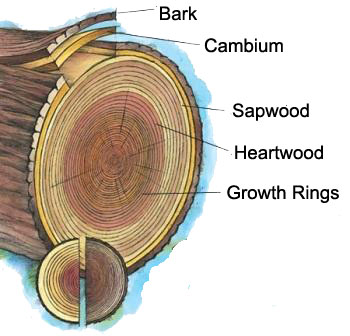
The bark is the tree’s protective outer shell. It shields the tree from insects, disease, fire, and harsh weather while helping reduce moisture loss. Although bark isn’t used to make lumber, it rarely goes to waste. Many sawmills recycle it into mulch, landscaping products, or biomass fuel that helps power mill operations.
Cambium
Just beneath the bark is the cambium, one of the most important layers of a living tree. This thin layer produces new wood on the inside and new bark on the outside, allowing the tree to grow wider each year. While the cambium itself isn’t used in lumber, it’s responsible for creating every board that will eventually be cut from the tree.
Sapwood
Sapwood is the lighter-colored outer wood that carries water and nutrients from the roots to the leaves. Because it is younger wood, it generally contains more moisture and is often lighter in color. In many species, sapwood provides excellent structural strength and is commonly found in framing lumber and other construction products.
Heartwood
Heartwood is the darker, older wood found at the center of the tree. As the tree ages, this wood no longer transports water and instead becomes denser and more durable. Many species naturally develop greater resistance to decay and insects within the heartwood, making it highly desirable for appearance-grade lumber, decking, outdoor projects, and fine woodworking.
Growth Rings
Each year, a tree forms a new growth ring. These rings tell the story of the tree’s life, revealing its age and the growing conditions it experienced. Trees that grow slowly often produce tighter growth rings, which can create denser wood in some species. Growth rings also influence grain pattern, stability, appearance, and the character of finished lumber.
How Tree Anatomy Shapes Lumber
Every board carries the history of the tree it came from. The amount of sapwood and heartwood, the spacing of growth rings, and the overall health of the tree all influence the lumber’s strength, durability, appearance, and best use. That’s why experienced sawmills carefully evaluate each log before cutting it, ensuring every tree is used to its fullest potential.
More Than Just Wood
A tree is an incredible natural engineering system. Each layer has a purpose long before it becomes lumber, and together they create one of the world’s most renewable and versatile building materials. The next time you see a piece of lumber, remember that every board began as a carefully designed structure built by nature itself.